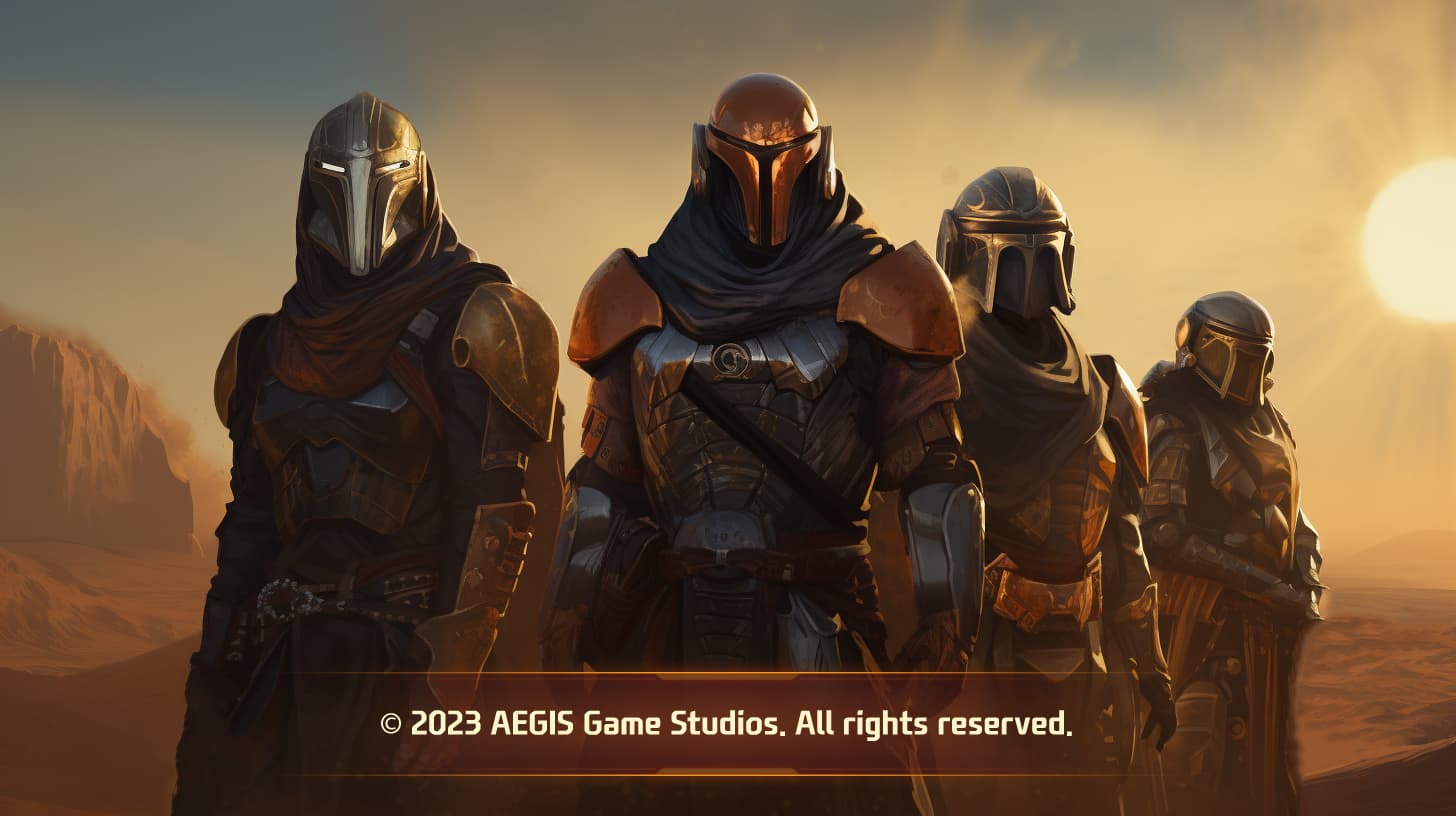
In the arid expanse of Esoris, a land that bore the scars of relentless desert winds and the echoes of ancient ambitions, there arose a resilient and formidable group of beings known as the “Dune Riders of Esoris.” These stalwart individuals were the descendants of Titans, those once-ethereal beings from the now-lost world of Aertheria, whose civilization was characterised by the harmonious fusion of artistry, technology, and the revered substance known as Aether. These descendants of Titans had embarked on a relentless journey, not to recapture their past, but to secure their future in a realm far removed from the celestial wonders of their ancestors.
The Dune Riders’ existence was a testament to both their indomitable spirit and their unwavering commitment to preserving their heritage. They donned armour that bore the weight of millennia, a testament to their lineage and a symbol of their unbreakable connection to their Titan forebears. This armour, forged in the old Titanic way, was crafted from a rare and precious material known as Titansteel, a substance that was once smelted in the Titans’ ancestral home.
Each set of Titansteel armour was a relic of immeasurable value, representing not only the individual strength and prowess of the Titans who once wore them but also the enduring legacy of their people. These armors were distinctive, intricately adorned with ornate designs that evoked the celestial beauty of Aetheria. Each house among the Dune Riders possessed a unique set of armour, passed down through generations with utmost reverence.
The preservation of these Titansteel armors became a sacred duty among the Dune Riders. Despite the passage of countless years and the inevitable wear and tear of time, they had managed to safeguard these precious artefacts. The Titansteel, imbued with the essence of Aether, had proven itself virtually indestructible, a testament to the advanced craftsmanship of the Titans and properties of the small drops of Eternium that lay within.
The Dune Riders’ culture revolved around these cherished armours, which were more than mere pieces of equipment; they were living relics that bound the Dune Riders to their Titan heritage. The armour of each house was adorned with symbols and patterns that told stories of their ancestors, the achievements of their house, and the indomitable spirit that had carried them through millennia of hardship.
The belief that they would one day reclaim their lost homeland of Aetheria from the clutches of Dahlia, the harbinger of darkness, was a driving force behind the Dune Riders’ unwavering dedication. It was a dream passed down through generations, a beacon of hope in the unforgiving sands of Esoris. They knew that the journey to retake Aerinthia would be arduous, and it might take countless more generations, but their commitment remained unshaken.
When the Exodus began and the Humans left Tillaris and moved to Sor’res, the Dune Riders remained, believing the rest of their kind to be giving up on the hope of reclaiming Aetheria and defeating Dahlia.
In the harsh desert landscapes of Esoris, the Dune Riders honed their skills, not just as warriors but as guardians of their Titan legacy. They mastered the art of survival in a land where resources were scarce, drawing upon their ingenuity and resourcefulness to thrive. They formed tight-knit communities and cultivated a culture that prized unity, cooperation, and the pursuit of knowledge, echoing the values of their Titan ancestors.
Though their mortal existence in Fusicia was far removed from the ethereal beauty of Aetheria, the Dune Riders embodied the resilience of their people. They were bound by the echoes of their ancestral world, carrying forward the legacy of Titans, and embracing the boundless possibilities of their future in the ever-shifting sands of Esoris.